The content on this website is for informational purposes only and is not meant to replace professional or medical advice. See our full disclaimer.
What's really going on when ADHD brains can't stick to routines, hobbies, or systems. (+ a free tool!)
Hello ADHD friend,
Let's talk about something almost every ADHDer quietly deals with.
- The planners we swore would fix everything.
- The hobbies we loved for 2 days.
- The apps we downloaded with hope.
- The unfinished projects we started with passion and abandoned halfway.
Here's something you may not want to hear, but I hope it helps.
If you live with ADHD, you will likely never stick to one planner, one routine, one hobby, one system, or one method...forever.
I know that sounds blunt, but there is relief in saying it out loud.
You are not failing. You are not inconsistent. If anything, your pattern of abandoning things is consistent. 🙃
What if instead of beating ourselves up, we said:
"Thanks for your help during that season. I learned something. Now I get to choose what works next."
To understand why we drift away from things, let's look at what's actually happening in the ADHD brain.
And if you want help reflecting on your own patterns, grab our free Google Sheet reflection tool at the bottom of this post.

Jump to:
- Why Can't I Stick to a Routine With ADHD?
- The Dopamine Trap: Why ADHD Brains Lose Interest So Fast
- The "Interest-Based Nervous System" Concept
- Your Needs Keep Changing
- Shame Makes it Harder to Restart
- ADHD Brains Work Better with Flexible Systems
- How to Stick to things with ADHD?
- Steps you can take When You're Struggling to Stick With Something
- Free Google Sheet
- Free Download
Why Can't I Stick to a Routine With ADHD?
There are a few reasons for this, and one of the biggest is something called the Dopamine Trap.
The Dopamine Trap: Why ADHD Brains Lose Interest So Fast
New routines and hobbies feel amazing at first because they spark dopamine.
The novelty of something new gives us energy, possibility, momentum.
But novelty fades fast.
And when the dopamine drops, motivation drops with it. Which makes the tool, hobby, or routine feel flat, heavy, or completely invisible.
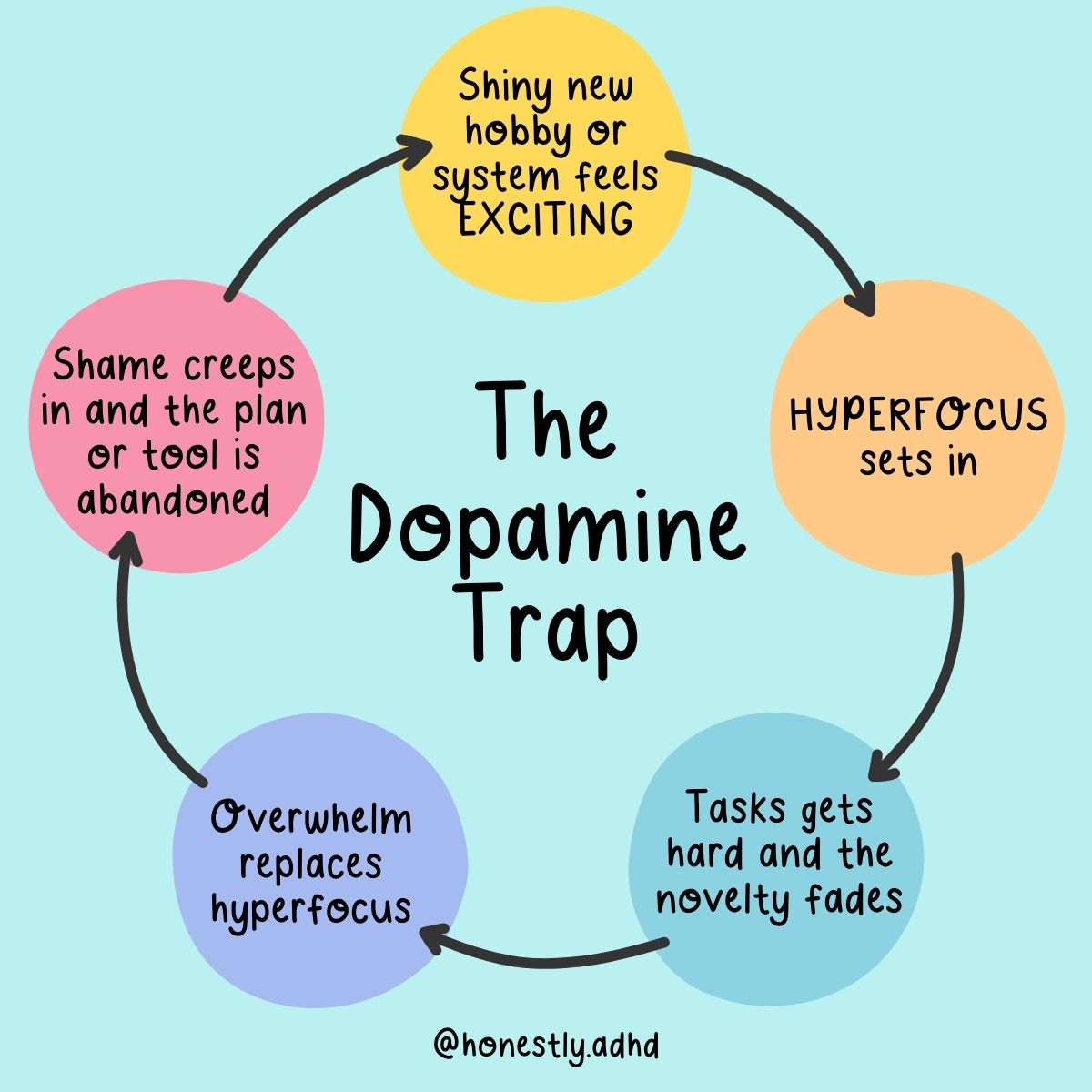
This is not a character flaw. It's a dopamine response.
Studies have shown that ADHD brains rely heavily on reward signals to stay motivated. When the initial reward fades, the motivation fades with it.1Evaluating dopamine reward pathway in ADHD: clinical implications
The "Interest-Based Nervous System" Concept
ADHD psychiatrist Dr. William Dodson 2How ADHD Shapes Your Perceptions, Emotions & Motivation coined the phrase "interest-based nervous system" to describe why the ADHD brain often can perform extremely well when something is:
- Interesting
- Novel
- Urgent
- Engaging
- Rewarding
And struggles when tasks are:
- Routine
- Boring
- Emotionally Flat
- Non-urgent
This explains why sticking to hobbies, planners, or routines feels easy one week and impossible the next.
Your Needs Keep Changing
ADHD executive function is not steady. It rises and falls depending on stress, interest, routines, sleep, emotions, and whatever season of life you are in.3ADHD, Executive Fatigue, and the Cognitive Weight of the Year's End
That is why:
- A planner that worked in January may fail you in April.
- A hobby that calmed you last month may overwhelm you now.
- A morning routine that felt effortless can disappear overnight when life changes.
Shame Makes it Harder to Restart
Falling behind for a few days often triggers shame.
That shame turns into avoidance.
Avoidance looks like laziness, but it's emotional regulation. The brain is protecting you from feeling judged by the tool, the system, or the project you abandoned.
This discouragement makes task initation harder.
So if you avoid reopening a planner or restarting a project, it is not because you do not want to. It is because your brain is reacting to discomfort, not the task itself.
ADHD Brains Work Better with Flexible Systems
Most planners, routines, habits, and productivity tools are designed for neurotypical brains with predictable days, predictable motivation, and predictable follow through.
ADHD lives do not work that way.
For many ADHDers, rigid systems become overwhelming. Flexible systems increase engagement, follow through, and the ability to return to things we could not stick to before.
What About "Unicorn" Planners or Tools?
Just because you may not stick to one rigid system forever does not mean you'll never find something that works for you.
Some ADHDers find what we call a unicorn tool thatsticks for years! And it's not because they changed personalities, but because the system bends and flexes with their real life.
A long lasting system that ADHDers stick to usually has three qualities:
- Flexibility
- Simplicity
- Space to drift and return, which prevents burnout
How to Stick to things with ADHD?
Sometimes the reason we stop is not the tool itself.
We abandon it because a feeling attached itself to it.
Ask yourself:
- Why am I avoiding this now?
- What emotion showed up that wasn't there before?
- Am I afraid of failing at it?
- Am I bored?
- Did I fall behind and now it feels embarrassing to return?
- Does it feel heavier than it did before because it reminds me of something stressful?
ADHD avoidance almost always hides an emotion underneath.
Steps you can take When You're Struggling to Stick With Something
I feel overwhelmed →
Break it into smaller steps and spread it out over time. Make your end goal more realistic.
I forgot about it →
Make it visible (on the counter, phone reminder, printed copy).
I hate it now→
First, take a break. Then set a timer to work on it for only 5 minutes to see if it really is bad as you think it is. Remember to take frequent breaks to avoid feeling burnt out or overwhelmed.
The novelty wore off and I am bored →
Pair it with music, a podcast, an audiobook, or a favorite show.
I just need a break →
Set it aside guilt-free and schedule a time to come back when your brain feels refreshed.
It never really fit my brain →
Simplify it, retire it, or switch to a more ADHD-friendly version.
Something else feels more exciting →
Schedule a return later so you can enjoy the new thing now without guilt.
I'm scared of failing →
Ask if the fear justified, or if it is just emotional friction.
It feels heavy now →
Change the environment so it feels new again (Park, Coffee Shop, clean desk, etc.)?
If reconnecting feels good, you found your way back.
If reconnecting still feels heavy…You are allowed to release it.
Free Google Sheet
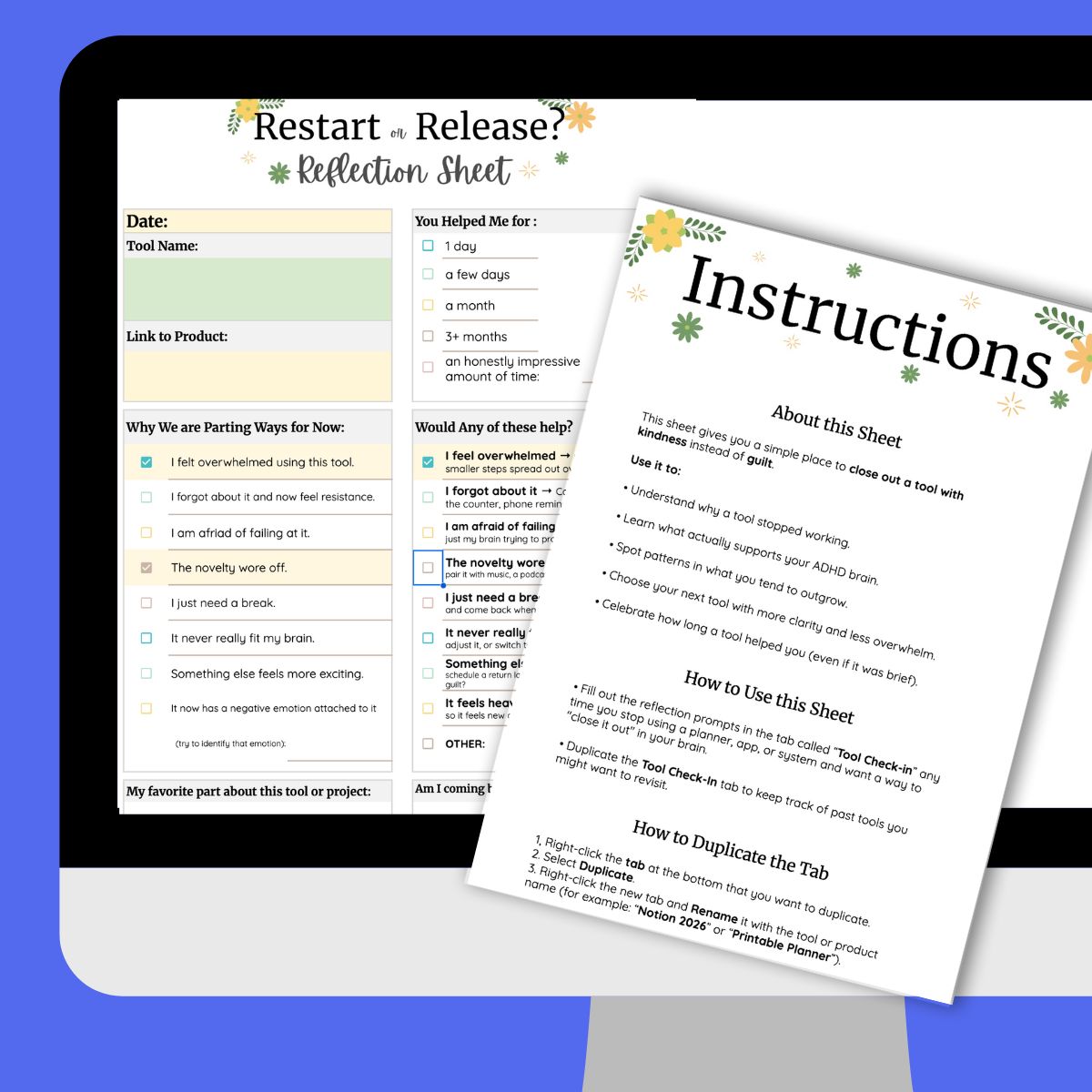
If you want support deciding whether to restart or let go, you can use our free Google Sheet reflection tool.
It helps you notice what season you were in, what emotion showed up, and whether the hobby or system still fits your life now. You can also print it if you prefer paper by following the instructions on the google sheet.👇
Free Download
🖨️ Under the purple heading below, click on the image or the title to download your free PDF(s).
*Free printables by Honestly ADHD are for personal, non-commercial use only. See our FAQ page for more details.*
👇 Click the Image or Title Below to Download

If you enjoyed this content, please consider sharing it! We welcome the use of one of these images with visible credit to Honestly ADHD and a direct link to the article. We appreciate your support!
References:
- 1
- 2
- 3



We'd love to hear from you