The content on this website is for informational purposes only and is not meant to replace professional or medical advice. See our full disclaimer.
ADHD vs. VAST: Why the Words We Use Can Shift Shame Into Strength.
So you've stumbled across the word VAST in an ADHD forum, podcast, or TikTok rabbit hole. Some people love it. Some aren't convinced. And maybe you're wondering:
- Is VAST just another name for ADHD?
- Do I have VAST instead of ADHD?
- Or is this one of those internet buzzwords that makes everything sound cooler than it is?
Let's dig into what the science says, what Dr. Hallowell and others mean by VAST, and why both terms matter (and which one to use when).

Jump to:
🧠 First ADHD: The Official Diagnosis
Quick refresher: ADHD = Attention-Deficit/Hyperactivity Disorder. It's a neurodevelopmental condition that affects the brain's executive function (aka all the skills that help us plan, focus, regulate emotions, and get through daily life without melting down over socks).
ADHD shows up differently for everyone, but here are some of the most common traits - all tied to executive function challenges:
- Trouble with focus (and also hyperfocus when it's something we like)
- Impulsivity (words and actions that pop out before we're ready)
- Time blindness (when "five minutes" = two hours later)
- Emotional intensity (aka the big feelings over "small" stuff)
- Organization struggles (backpacks, bedrooms, inboxes = chaos)
- Hyperactivity, though not always (there's inattentive ADHD too)
For decades, ADHD has been the official diagnosis recognized in the DSM-5 (Diagnostic and Statistical Manual of Mental Disorders) by the American Psychiatric Association.
🔍 Enter VAST: Reframing ADHD
VAST stands for Variable Attention Stimulus Trait. It's not a medical diagnosis. It's a term coined by Dr. Edward (Ned) Hallowell and John J. Ratey, introduced in their book ADHD 2.0: New Science and Essential Strategies for Thriving with Distraction.

Why the name VAST? Because Dr. Hallowell (and a lot of adults with ADHD) didn't love the name "Attention Deficit Disorder." It sounds negative, deficit-focused, and doesn't capture the whole ADHD experience.
Here's what that VAST emphasizes in plain language:
- ADHD brains aren't "deficient."
- Attention isn't missing-it's variable. Sometimes laser-focused, sometimes scattered.
- The ADHD brain is stimulus-driven-it lights up with novelty, interest, or urgency.
In other words, it's not about "not paying attention." It's about paying attention differently.
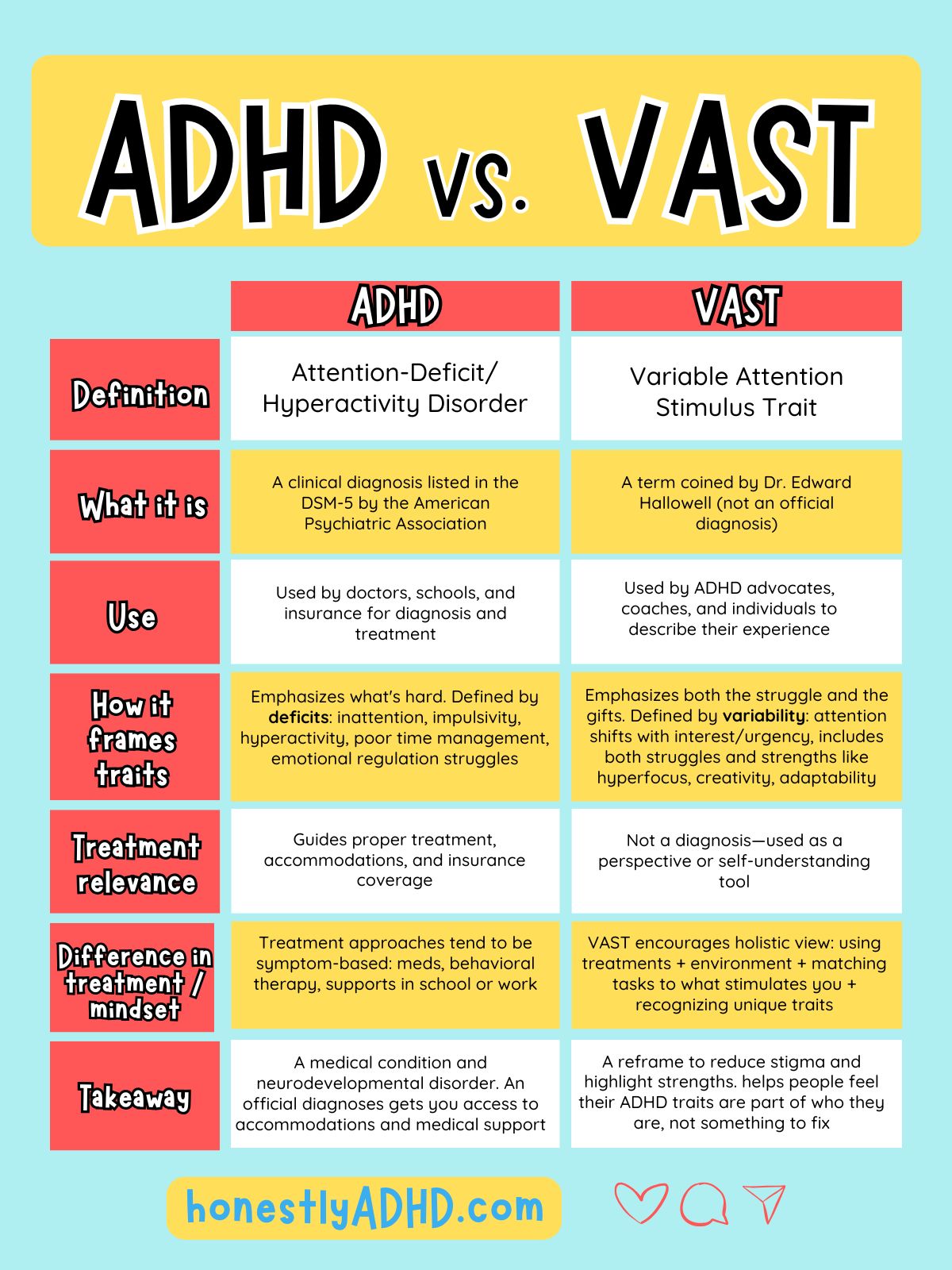
💡VAST vs ADHD: Side-by-Side Comparison
We've included both a colorful infographic and a simple text chart below for easy reference.1ADHD 2.0: New Science and Essential Strategies for Thriving with Distraction - from Childhood Through Adulthood by Dr. Edward Hallowell & Dr. John Ratey (2021)
| ADHD | VAST | |
| Definition | Attention-Deficit/Hyperactivity Disorder | Variable Attention Stimulus Trait |
| What it is | A clinical diagnosis listed in the DSM-5 by the American Psychiatric Association | A term coined by Dr. Edward Hallowell (not an official diagnosis) |
| Use | Used by doctors, schools, and insurance for diagnosis and treatment | Used by ADHD advocates, coaches, and individuals to describe their experience |
| How it frames traits | Defined by deficits: inattention, impulsivity, hyperactivity, poor time management, emotional regulation struggles | Defined by variability: attention shifts with interest/urgency, includes both struggles and strengths like hyperfocus, creativity, adaptability |
| Treatment relevance | Guides proper treatment, accommodations, and insurance coverage | Not a diagnosis—used as a perspective or self-understanding tool |
| Difference in treatment / mindset | Treatment approaches tend to be symptom-based: meds, behavioral therapy, supports in school or work | VAST encourages holistic view: using treatments + environment + matching tasks to what stimulates you + recognizing unique traits |
| Takeaway | A medical condition and neurodevelopmental disorder. An official diagnosis gets you access to accommodations and medical support | A reframe to reduce stigma and highlight strengths. Helps people feel their ADHD traits are part of who they are, not something to fix |
🌟 Why Prefer VAST?
Dr. Hallowell and many in the ADHD community like VAST because it reframes the experience:
- It feels less stigmatizing. The current term ADHD often leads to shame, guilt, or feelings of being "less than." "Disorder" sounds broken. "Trait" feels human.
- It focuses on variability, not deficit. Attention shifts with interest, novelty, or emotional state-sometimes distracted, sometimes hyperfocused.
- It recognizes strengths as well as struggles. ADHD traits can include creativity, enthusiasm, curiosity, adaptability, and out-of-the-box thinking.2 The ADHD Advantage: A Q&A with Dr. Ned Hallowell for Parents of Children with ADHD
- It reduces shame. The ADHD label can fuel negative feedback loops-shame, guilt, feeling "less than." VAST emphasizes pride, hope, and self-acceptance.
- It applies more broadly. Not everyone with attention challenges fits the full ADHD diagnosis, but many still identify with VAST. It gives language to a wider range of attention styles.
- It pairs with effective strategies. Just like ADHD, VAST needs practical tools: routines, coaching, environmental tweaks, cognitive behavioral therapy, and strength-based approaches.
❤️ Final Thoughts and Why it Matters
So why should you even care about the difference between VAST and ADHD?
Because how you name things changes how you feel about them-and what choices you make.
- If you only see ADHD as a disorder, you might only see the negatives and miss the rose-colored parts of it (creative thinking, energy, novelty seeking).
- If you lean into VAST, you can build a self-image that includes your strengths and not just your struggles.
Whichever term you use, you'll likely still need supportive tools (therapy, medication, executive function supports), especially if symptoms are getting in the way of daily life.
Here's what feels true to us:
ADHD = the diagnostic framework.
VAST = a self-understanding framework
You can use ADHD to access supports, get diagnoses, work with your doctor. You can use VAST to reframe how you see yourself, reduce shame, amplify what's good about your neurotype.
You are more than the label and the goal is the same-finding strategies, support, and self-compassion so you can thrive.
References:
- 1
- 2




We'd love to hear from you