The content on this website is for informational purposes only and is not meant to replace professional or medical advice. See our full disclaimer.
When Everything Feels Urgent, an ADHD Priority Matrix Gives You Clarity
Raise your hand if you've ever stared at your to-do list and immediately felt… paralyzed.
Do I start the laundry? Answer emails? Tackle a big work project? Ahhhh-it's too much. 🤯 I think I'll just doom-scroll TikTok and call it "research." 😔
For ADHD brains, prioritizing often feels impossible. Every task can feel equally important, which makes decision-making overwhelming.
That's the trap. We bounce between overwhelm and avoidance, and the to-do list only grows longer.
That's why we love priority matrices for ADHDers. They give your brain a visual map. Instead of wasting all your energy just deciding what to do first, you can see at a glance which tasks are worth your time and which ones can wait.
✨ Use our free PDFs at the bottom of this post to outsource the decision-making part of your brain so you can actually start.

Jump to:
Which Is the Best Priority Matrix for ADHD Brains?
A prioritization matrix is a simple chart that sorts your tasks into four boxes. The two big ones you'll hear about are:
- The Eisenhower Decision Matrix: it sorts tasks by urgent vs. important.
- The Impact Effort Matrix: it sorts tasks by how much they matter vs. how much energy it'll take.
These are especially helpful if you have ADHD, since executive function skills like decision-making don't always come easily.
Our Pick
Our favorite is the Impact Effort Matrix because for ADHDers, most tasks feel equally important/ urgent until the last possible minute (thanks, time blindness!). But there's a time and place for both matrices.
✨ When to Choose the Impact Effort Matrix
- Best when you're self-managing projects without clear deadlines (home, business, creative work).
- Perfect for non-urgent tasks that still matter: cleaning, decluttering, planning content, building routines.
- Great if you struggle with adhd paralysis because everything feels urgent.
✨ When to Use the Eisenhower Matrix
- Best when you're dealing with deadlines, bosses, teachers, or clients.
- Great for sorting a long to-do list that's full of nagging tasks (emails, phone calls, due dates, appointments).
- Helps with crisis-mode days when deadlines are stacked.
Impact Effort Priority Matrix (Our Favorite)
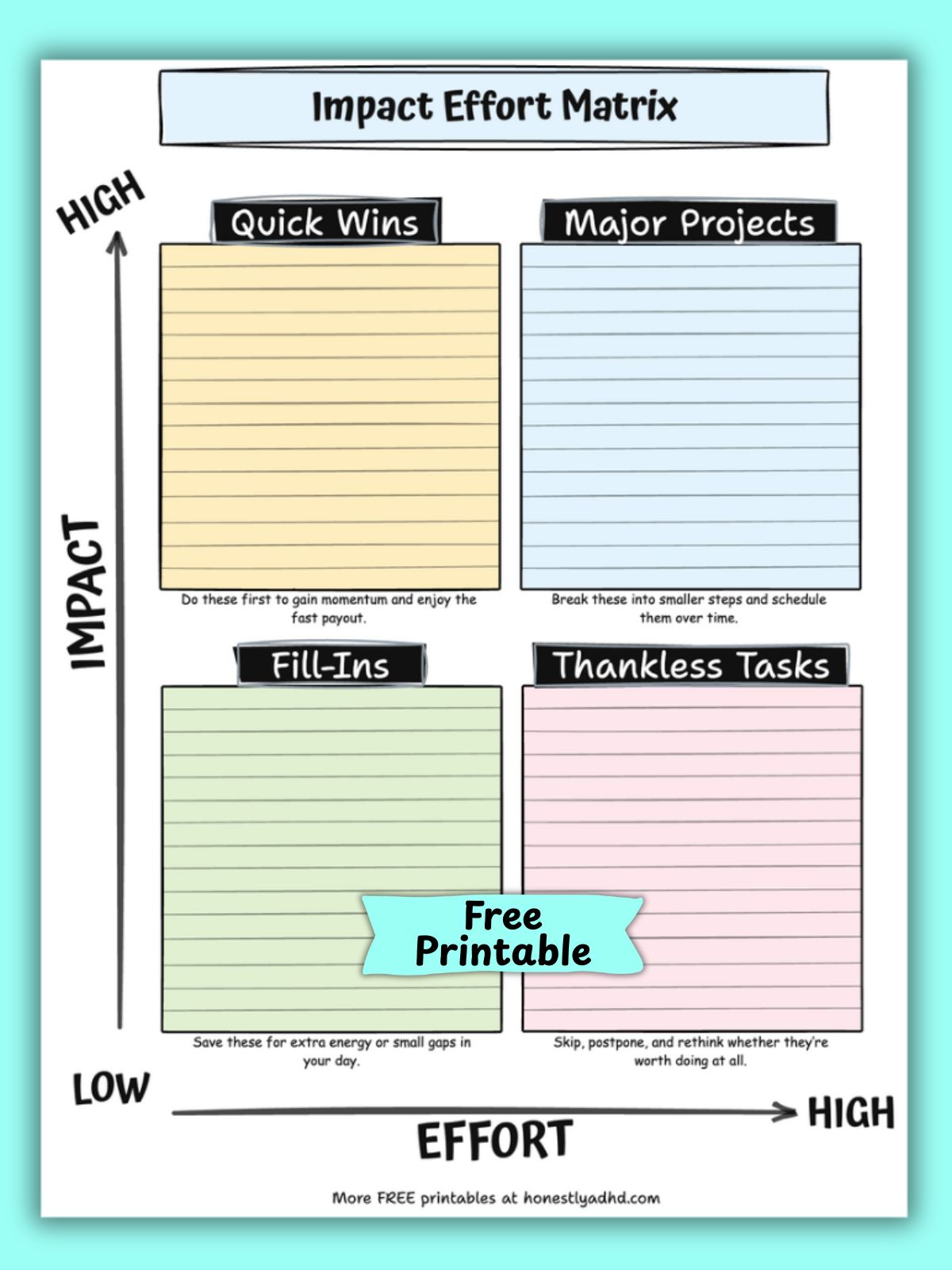
The Impact Effort Matrix (sometimes called the Action Priority Matrix) was popularized by Dave Gray.1Gamestorming: Impact & Effort Matrix It's a tool to help teams and individuals prioritize by balancing "how much impact will this have?" against "how much effort will this take?"
This matrix keeps overwhelm down and momentum up. Instead of guessing where to start, you're choosing based on energy and payoff.2Tuzzit:The Impact Effort Prioritisation Matrix
Ask:
👉 Will this make a big difference?
👉 Will it drain me or be a quick win?
The Impact-Effort Matrix is especially ADHD-friendly because it works even when tasks feel equally important. For example: cleaning projects, self-employed work, or routines that don't demand attention until they pile up.
Impact = the payoff
- How will having this done affect my quality of life-financially, emotionally, or otherwise?
- Will it reduce stress, free up time, or make my day easier?
- How happy or relieved will I feel when it's complete?
Effort = the cost
- How much energy will this take, knowing my ADHD brain?
- How much time will it eat up: five minutes, or a whole afternoon?
- Will I need help, tools, or extra steps to get it done?
Here's how the four categories break down:
Quick Wins (High Impact, Low Effort)
The sweet spot.
Do these first. They're motivating and build momentum.
Examples:
- Send one important email
- Schedule a doctor's appointment
- Prep meds for the week
- Make the bed
Major Projects (High Impact, High Effort):
Worth it, but needs planning.
These are your long-term goals and routines: the things that actually build the life you want, but often get buried under whatever feels loudest in the moment.
Examples:
- Write a client proposal
- Start a new workout routine
- Organize the garage
- Create a Meal Plan
Break these into smaller chunks. They matter, but you'll burn out if you try to do them all at once.
Fill-Ins (Low Impact, Low Effort):
Fine for in-between moments.
Save them for when you're waiting, on the phone, or need a mental break.
Examples:
- Delete old screenshots
- Fold towels
- Tidy your desk
- Wipe down counters
Thankless Tasks (Low Impact, High Effort):
Skip or Postpone Indefinitely
These are the time drains. Either delegate, limit, or rethink whether they're worth doing at all.
Examples:
- Scrubbing baseboards
- Rewriting a perfectly fine email
- Re-color-coding a spreadsheet that already works
- Deep clean fridge
Why the impact action matrix works with our ADHD brain:
It lowers executive dysfunction, reduces decision fatigue, and helps match your energy levels to the right task. Instead of tackling the hardest thing first or avoiding the whole list, you focus on what actually moves the needle.
Eisenhower Priority Matrix
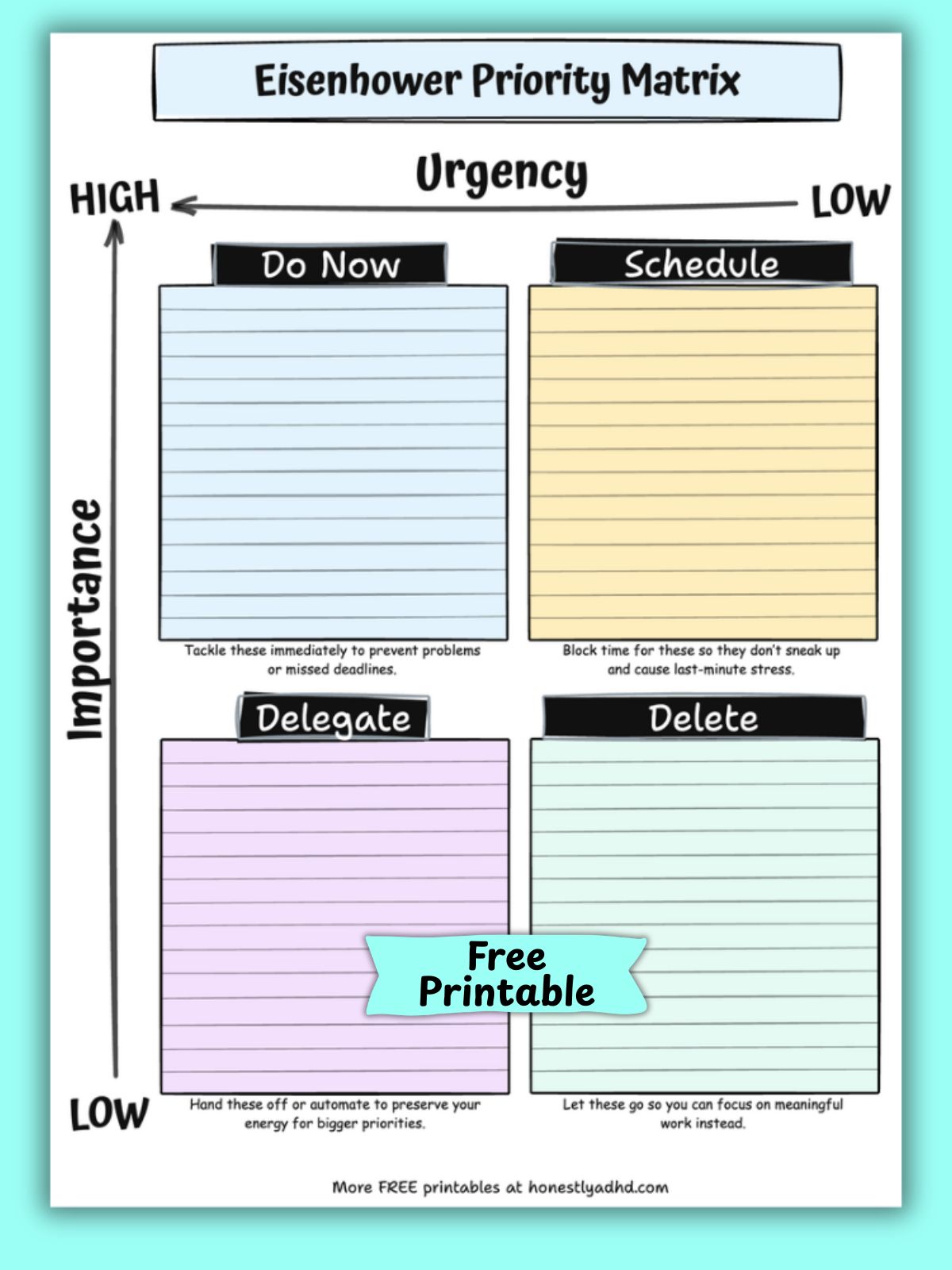
The Eisenhower Matrix is named after President Dwight D. Eisenhower, who is credited with saying, "What is important is seldom urgent, and what is urgent is seldom important."3Quote Investigator: What is important is seldom urgent...
His time management methods inspired today's version of the "Urgent-Important Matrix."
Ask:
👉 What absolutely must happen today vs. what can be scheduled, delegated, or dropped?
It's a simple task management tool that sorts your to-do list into four quadrants4Todoist: The Eisenhower Matrix:
Do First (Urgent + Important):
These are the "little fires" that need immediate attention or have an upcoming deadline.
Examples:
- Finish a project due tomorrow
- Pay your electric bill before the cutoff
- Schedule a vital doctor's appointment
Schedule (Important but Not Urgent):
Tasks that matter, but don't have to be done today. Put them on the calendar so you know exactly when they'll get handled.
Examples:
- Reply to that email Thursday morning
- Plan the dentist appointment next week
- Block time on Saturday to work on the presentation
Delegate (Urgent but Not Important):
Stuff that feels like it needs doing right now, but doesn't have to be you.
If you don't have someone to delegate to, see if you can automate or simplify.
Examples:
- Ask your partner to handle tonight's dinner.
- Automate bill payments instead of tracking them manually.
- Hire a handyman to fix the leaky faucet.
- Forward routine data entry to an assistant.
Delete (Not Urgent + Not Important):
The sneaky time-wasters. Tasks that take energy without adding value.
Examples:
- Skip the volunteer project you don't have time for
- Decline a meeting you're not really needed for
- Don't paint the backyard shed that no one notices*
*It's ok to delete for now-- you can always add it onto the schedule at a later date, when you have more time.
The Eisenhower approach helps you think about clear consequences and future planning, especially when a due date or time pressure is real.
How to Use Our Free Printable Matrix PDFs
Here's how to make it work in real life:
- Brain dump your entire list. Get it all out of your head and onto paper.
- Sort each task into a quadrant using the guiding questions.
- Start with Quick Wins or Urgent Tasks. Easy momentum is your best friend.
- Schedule Major Projects and Big Tasks into smaller steps (and don't overload one day). Use our Goal Planner Worksheet to help.
Print out your preferred ADHD Priority Matrix, stick it on your fridge, and use it to sort your daily routine.
Free Printable
🖨️ Under the purple heading below, click on the image or the title to download your free PDF(s).
*Free printables by Honestly ADHD are for personal, non-commercial use only. See our FAQ page for more details.*
👇 Click the Image or Title Below to Download

If you enjoyed this content, please consider sharing it! We welcome the use of one of these images with visible credit to Honestly ADHD and a direct link to the article. We appreciate your support!
References:
- 1
- 2
- 3
- 4

We'd love to hear from you