The content on this website is for informational purposes only and is not meant to replace professional or medical advice. See our full disclaimer.
Five ways to break out of ADHD paralysis, and how to tell which one you need. Free decision tree printable included.
You're sitting on the couch. You know you need to start the laundry. You WANT to start the laundry. The basket is right there, mocking you.
And you cannot move.
It's been 45 minutes. Maybe two hours. You're not relaxing. You're not enjoying yourself. You're just... frozen.
That's ADHD paralysis. And the reason generic advice bounces off it is that there isn't one version of it - there are five, and they need different things from you.

Jump to:
- What Is ADHD Paralysis?
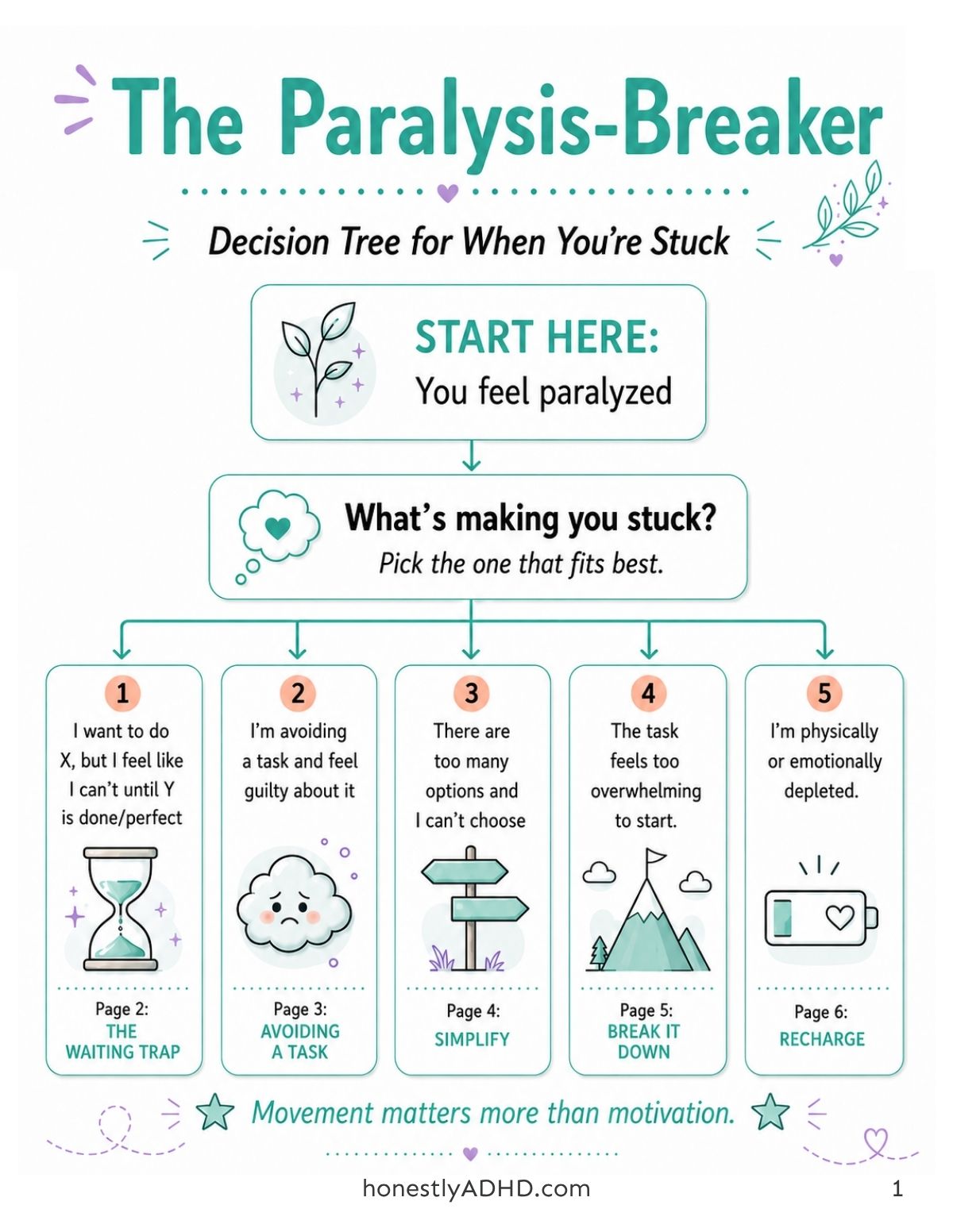
- Examples of ADHD Paralysis: The 5 Most Common Traps
- #1: The Waiting Trap (Perfectionism Paralysis)
- #2: Avoiding a Task and Feeling Guilty About it
- #3: Too Many Options (Choice Paralysis)
- #4: The Task Feels Too Big (Task Paralysis)
- #5: You're Depleted
- ADHD Paralysis vs Procrastination: What's the Difference?
- Why Does ADHD Paralysis Happen?
- How to Stop ADHD Paralysis: Effective Strategies That Actually Work
- When to Seek Professional Support
- The Paralysis-Breaker: Free Printable
- Free Printable
What Is ADHD Paralysis?
ADHD paralysis is a mental state where you feel completely frozen when faced with a task, decision, or to-do list.
You want to act. You know what needs to happen. But your brain refuses to cooperate.
It's a specific manifestation of executive dysfunction, the core feature of ADHD that makes it hard to plan, prioritize, and start tasks.
Even though ADHD paralysis isn't a formal diagnosis, it's a common experience for the ADHD brain. The Child Mind Institute breaks it down into three different types1https://childmind.org/article/what-is-adhd-paralysis/:
- Mental paralysis: Your brain becomes overloaded with too much information, too many thoughts, and sensory overload. You can't process it all, so the system shuts down.
- Choice paralysis (also called analysis paralysis): You have too many options and can't make any decision. Fear of making the wrong decision keeps you frozen.
- ADHD Task paralysis: You can't start the task in front of you, even when you want to and know how to do it.
You might experience all three different forms at different times. Identifying which type of ADHD paralysis you're in is the first step to getting out.
Signs You're in ADHD Paralysis (Not Just Procrastinating)
Here are common signs you're experiencing ADHD paralysis rather than typical procrastination:
- You want to start the task but physically cannot make yourself move
- You're scrolling, staring, or zoning out without enjoying it
- You feel a weird heavy fog between you and what needs to be done
- You keep telling yourself "just five more minutes" for hours
- You feel guilty, anxious, or ashamed but still can't move
- Even small decisions feel impossibly big (this is decision fatigue)
- You experience time blindness, where hours pass without you realizing
- You may shut down completely, sometimes called ADHD shutdown
If you're nodding along, you're not alone.
Examples of ADHD Paralysis: The 5 Most Common Traps
ADHD paralysis shows up differently depending on what's blocking you. Here are the five most common patterns and how to handle each one. Each one needs different strategies, which is why a one-size-fits-all approach doesn't work for ADHD.
#1: The Waiting Trap (Perfectionism Paralysis)
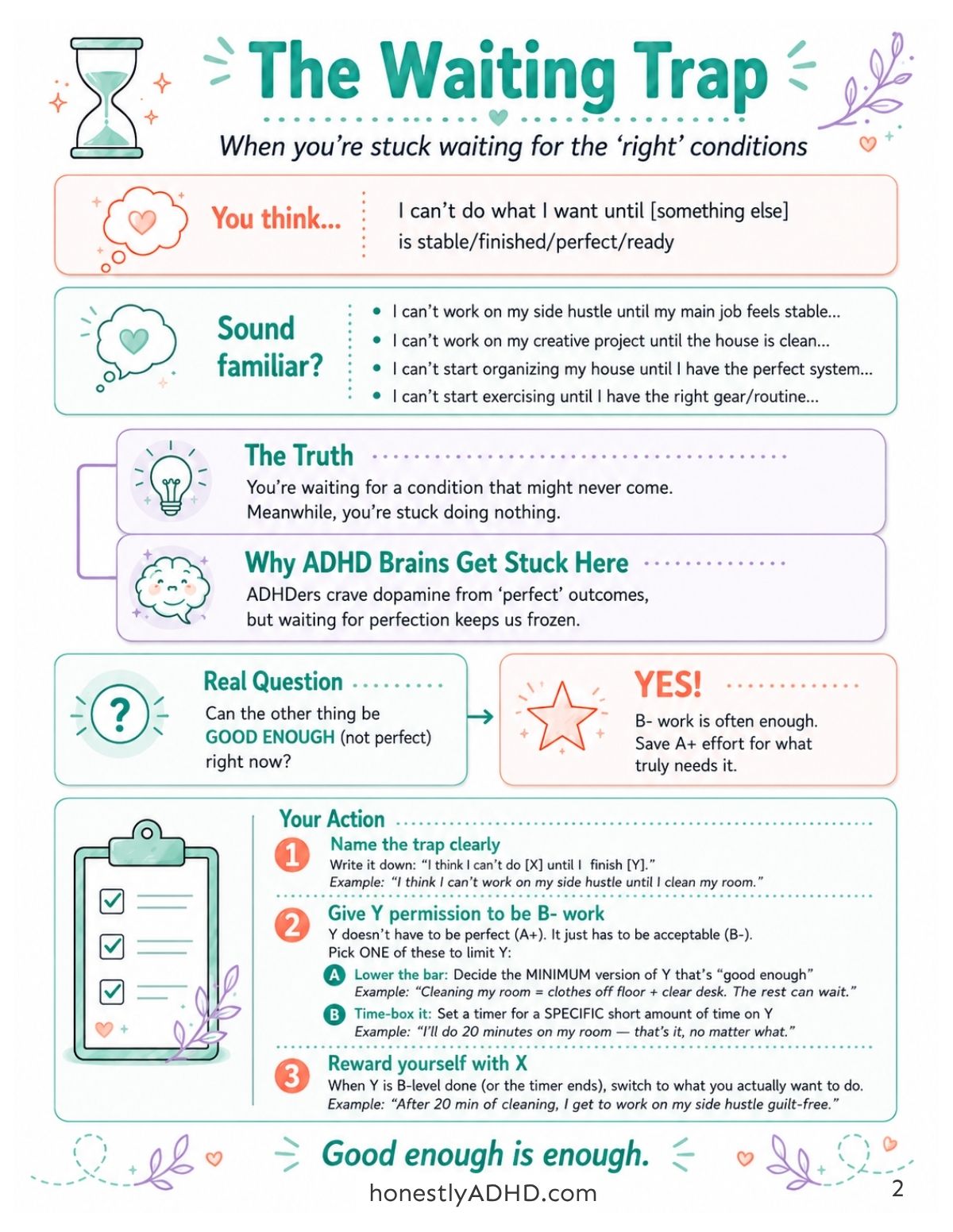
"I can't do what I want until something else is finished or perfect."
This is the perfectionism trap. You're convinced you can't start the thing you actually want to do until some other condition is met first. The condition usually involves perfection.
Common examples:
- "I can't work on my side hustle until my main job feels stable."
- "I can't work on my creative project until the house is clean."
- "I can't start organizing my house until I have the perfect system."
- "I can't start exercising until I have the right gear."
ADHDers often crave dopamine from "perfect" outcomes, but waiting for perfection keeps us frozen. The condition you're waiting for usually isn't actually required. You're waiting for permission.
How to escape it: One way to escape ADHD paralysis is to give yourself permission to create B- work. It doesn't need to be A+. Pick a minimum acceptable version, do that, then move to what you actually want.
Real example: "Cleaning my room = clothes off floor + clear desk. The rest can wait. After that, I work on my side hustle guilt-free."
#2: Avoiding a Task and Feeling Guilty About it
"I keep putting this off and I feel terrible about it."
Sometimes when you're avoiding a task, doing it later actually IS the smart move.
Other times you're avoiding it because your brain has labeled it as unpleasant and won't engage. Knowing the difference matters.
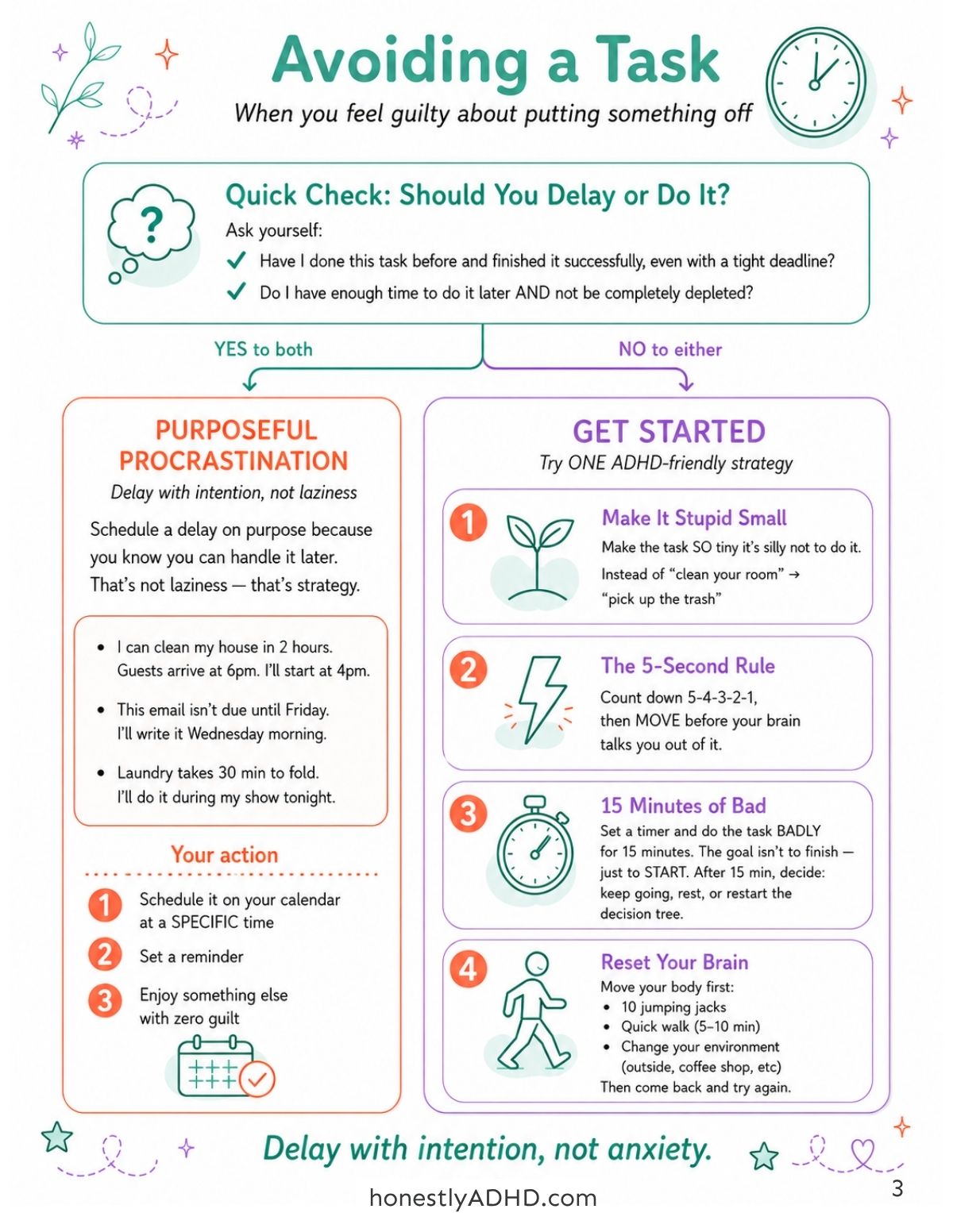
First ask yourself two questions:
- Have I done this before successfully, even with a tight deadline?
- Do I have enough time later AND will I have energy left?
If YES to both, you can purposefully procrastinate. Schedule it on your calendar at a specific time, set a reminder, and enjoy something else without guilt.
If NO to either, you need to start now. But not by forcing yourself through pure willpower. Try one of these ADHD-friendly strategies:
- Make it stupid small. Instead of "clean your room" try "pick up the trash." Break the entire task into the smallest possible step. The smaller, the better.
- The 5-second rule. Count down 5-4-3-2-1, then move before your brain talks you out of it.
- 15 minutes of bad. Set a timer and do the task badly for 15 minutes. The goal isn't to finish or do it well. The goal is to start. After 15 minutes you can decide if you want to keep going. Often, you will, because you've broken the inertia.
- Reset your brain. Do 10 jumping jacks, take a quick walk, or change your environment. Sometimes the body needs to move before the brain can.
#3: Too Many Options (Choice Paralysis)
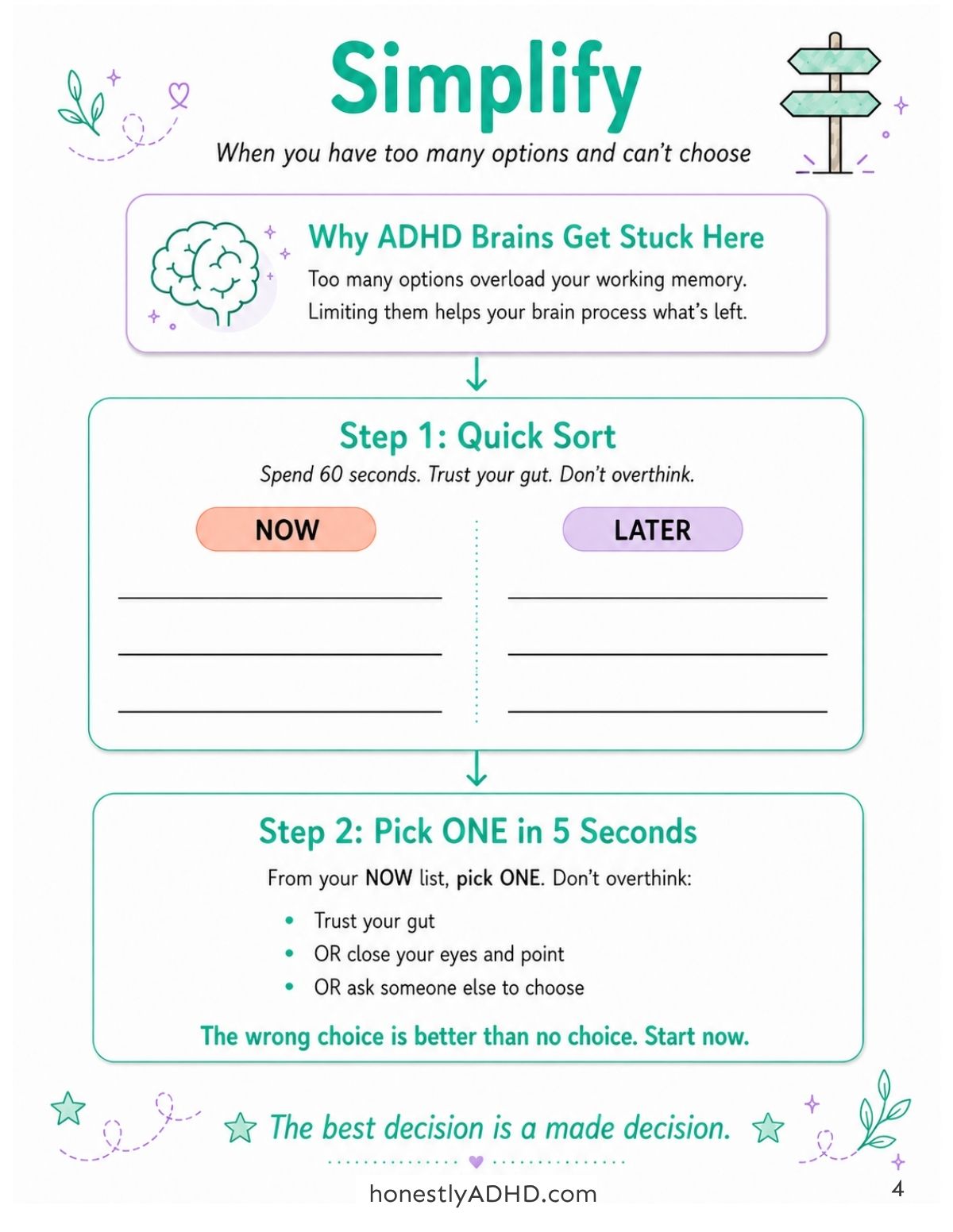
"There are too many things to do and I can't pick."
Too many options overload your working memory and trigger analysis paralysis. Your ADHD brain freezes because it can't process all of them at once.
How to escape it: Quickly sort your options into two columns: NOW and LATER. Spend 60 seconds. Trust your gut. Don't overthink. This breaks the analysis paralysis loop.
Then from your NOW list, pick ONE in 5 seconds. Don't deliberate. Trust your gut, close your eyes and point, or ask someone else to pick for you. The wrong choice is better than no choice.
#4: The Task Feels Too Big (Task Paralysis)
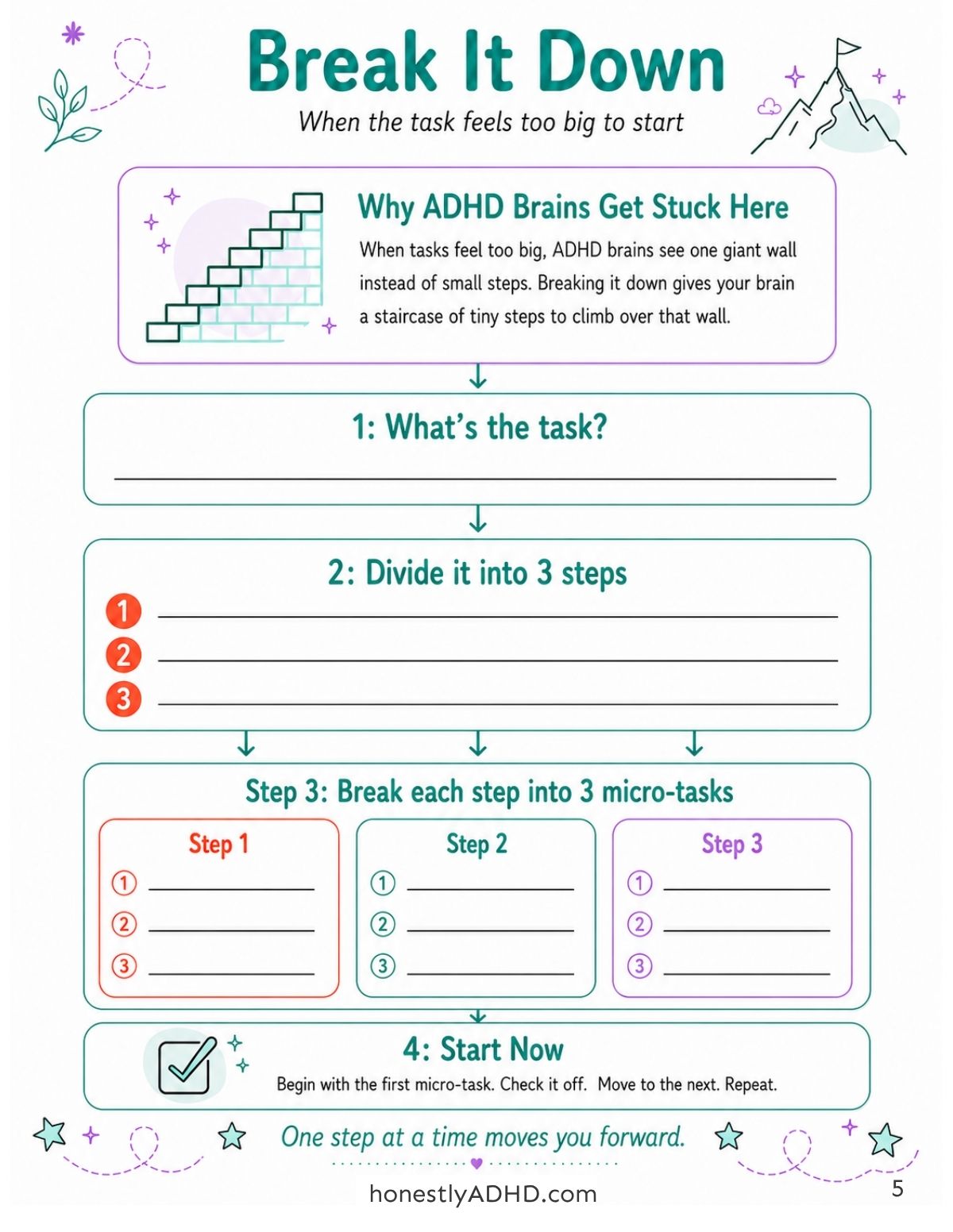
"I don't even know where to start."
This is classic ADHD task paralysis. When tasks feel huge, ADHD brains see one giant wall instead of small steps. Your brain shuts down because the task seems impossible to complete.
How to escape it: Break tasks into manageable steps. Take the big task and divide it into 3 steps. Then break each of those steps into 3 micro-tasks. You now have 9 tiny actions instead of one impossible wall.
Start with the first micro-task only. Don't look at the rest. Check it off. Move to the next. Repeat.
Real example: "Write a blog post" becomes "Open document → Write title → Write three bullet points → Write intro paragraph..."
#5: You're Depleted
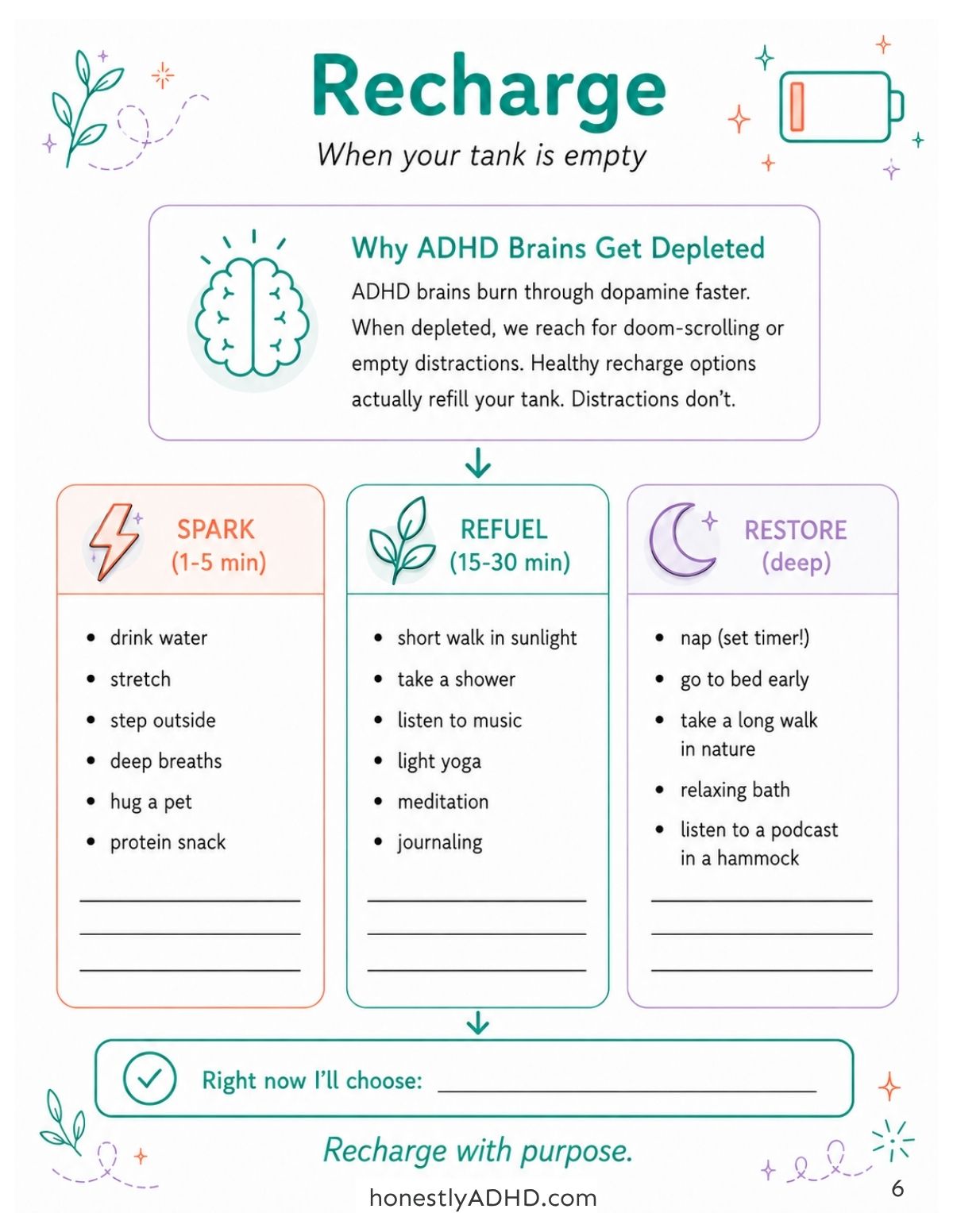
"I have nothing left to give."
Sometimes paralysis isn't about the task.
You're empty. ADHD brains burn through dopamine faster, and when the tank is dry, you can't push through. This is often mistaken for laziness but it's actually depletion.
When depleted, most of us reach for doom-scrolling or empty distractions. Those don't recharge anything. They just delay the crash.
How to escape it: Choose something that actually refills your tank. Pick based on how much time you have:
Got 1-5 minutes? Drink water, stretch, step outside, take deep breaths, hug a pet, eat a protein snack.
Got 15-30 minutes? Short walk in sunlight, take a shower, listen to music, light yoga, meditation, journaling.
Need a deep recharge? Take a nap with a timer, go to bed early, take a long walk in nature, take a relaxing bath, or listen to a podcast in a hammock.
ADHD Paralysis vs Procrastination: What's the Difference?
Typical procrastination is choosing to delay a task. You don't want to do it, so you put it off.
ADHD paralysis is different. You want to do the task. You know it matters. But you literally cannot make yourself start.
That's why "just push through" doesn't work for ADHDers. This isn't about willpower or motivation. It's about how the brain's executive function and dopamine systems work differently in ADHD.
The shame spiral that comes with confusing ADHD paralysis with typical procrastination is also part of the problem. Beating yourself up for being "lazy" makes the paralysis worse, not better.
Why Does ADHD Paralysis Happen?
Short answer: it's your brain chemistry. ADHD paralysis happens because of specific differences in how the ADHD brain processes information, regulates emotions, and generates motivation.
1. Low Dopamine and the Motivation Problem
Dopamine is your brain's motivation chemical. In ADHD brains, dopamine signaling is dysregulated. Lower levels of dopamine mean your brain doesn't get the same "reward signal" from boring or low-stimulation tasks.
This is why mundane tasks can feel impossible to start, even when they're important. Your brain literally cannot generate the motivation. 2Deciphering dopamine dysregulation in adult ADHD
2. Executive Function Overload
Executive functioning is the set of mental processes your prefrontal cortex handles: planning, prioritizing, starting tasks, and switching between them. Research suggests 80-90% of adults with ADHD struggle with executive dysfunction daily.3Dr. Sharon Saline, "The ADHD Paralysis Trap
When too much input hits your brain at once, the system overloads and freezes. This is cognitive overload, and it's a major driver of ADHD shutdown.
Source: Dr. Sharon Saline, "The ADHD Paralysis Trap" (2025)
3. Decision Paralysis and Choice Overload
A 2025 study published in European Psychiatry found that 82% of adults with ADHD report frequent difficulties with decision-making, and 68% say decision paralysis significantly affects their work performance.4ADHD and Decision Paralysis: Overwhelm in a World of Choices
If you've ever stared at a menu for 20 minutes or rewritten the same email seven times, you're statistically normal for an ADHD brain. The fear of failure and fear of making the wrong decision combine with executive dysfunction to create complete decision-making shutdown.
4. Emotional Dysregulation Adds Fuel
Emotional regulation is harder for ADHD brains. When you're already stressed, anxious, or overwhelmed, that emotional dysregulation makes ADHD paralysis worse. Negative emotions like shame, guilt, and fear can completely freeze the brain's ability to take action.
How to Stop ADHD Paralysis: Effective Strategies That Actually Work
Beyond the five trap-specific solutions above, here are research-backed strategies that help with ADHD paralysis in general. Different strategies work for different people, so try a few to figure out what works best for you.
Body Doubling
Having another person nearby, even silently, dramatically improves task initiation for ADHD brains.
It can be in person, on a video call, or through a virtual coworking service. The other person doesn't need to do the same task. They just need to be there. This is one of the most effective strategies for chronic task paralysis.
The Pomodoro Technique
Work for 25 minutes, then take a 5-minute break. Repeat. The Pomodoro technique is one of the best time management tools for ADHD brains because it works with how we focus (in bursts) rather than against it.
Short, defined work periods reduce the overwhelm that triggers paralysis.
Change Your Environment
Sometimes your physical space is the problem. Too much clutter, noise, or just being stuck in the same spot for hours keeps your brain frozen.
Try working at a coffee shop, putting your phone in another room, decluttering the visible area, or just sitting in a different chair.
Sensory overload from your environment is often the hidden trigger.
Cognitive Behavioral Therapy
Cognitive behavioral therapy (CBT) can help address the underlying thought patterns that contribute to ADHD paralysis, especially perfectionism and fear of failure.
An ADHD coach or therapist who specializes in ADHD can help you build coping strategies tailored to your specific needs.
ADHD Medication
For many adults with ADHD, prescription medications are a foundational part of treatment. ADHD medication can help regulate dopamine and improve executive functioning, which directly reduces paralysis.
If you haven't talked to a healthcare professional about treatment options, that conversation might be worth having. This isn't medical advice. It's just a reminder that professional support is available.
Basic Self-Care Foundations
Sleep, hydration, balanced diet, and movement all directly affect dopamine levels and executive function. When these foundations are weak, ADHD paralysis hits harder.
What Doesn't Work when you're Paralyzed (Stop Doing These)
- Eating the frog. Telling an ADHD brain to "just do the hardest thing first" is the fastest way to guarantee nothing gets done.
- Shame spirals. Beating yourself up for being stuck makes the paralysis worse, not better.
- Vague to-do lists. "Clean house" is not a task. "Pick up clothes from bedroom floor" is.
- Waiting for motivation. ADHD brains don't get motivation the way neurotypical brains do. Action comes first. Motivation comes second.
- Trying to push through alone. Body doubling, accountability, and external structure work way better than willpower.
- Ignoring it. ADHD paralysis tends to get worse without intentional strategies, not better.
When to Seek Professional Support
ADHD paralysis is manageable with the right strategies. But if it's significantly affecting your daily life, work, or relationships, professional help can make a real difference.
Consider reaching out to a healthcare professional if:
- Paralysis is happening daily and you can't complete tasks at work or home
- You haven't been formally evaluated for ADHD
- You're experiencing low self-esteem or depression alongside ADHD
- Self-help strategies haven't worked and you need a personalized treatment plan
A formal diagnosis can open the door to treatment options including ADHD medication, cognitive behavioral therapy, and ADHD coaching.
None of this is medical advice, just a reminder that you don't have to figure this out alone.
The Paralysis-Breaker: Free Printable
Want the Free Visual Decision Tree?
All five of these traps and their solutions are mapped out in our free 6-page Paralysis-Breaker printable. It includes a visual decision tree that helps you identify which type of ADHD paralysis you're in right now, plus a dedicated worksheet for each trap with fillable lines for your specific situation.
Get the Free Printable below!
Free Printable
🖨️ Under the purple heading below, click on the image or the title to download your free PDF(s).
*Free printables by Honestly ADHD are for personal, non-commercial use only. See our FAQ page for more details.*
👇 Click the Image or Title Below to Download
If you enjoyed this content, please consider sharing it! We welcome the use of one of these images with visible credit to Honestly ADHD and a direct link to the article. We appreciate your support!
References:
- 1
- 2
- 3
- 4

We'd love to hear from you